
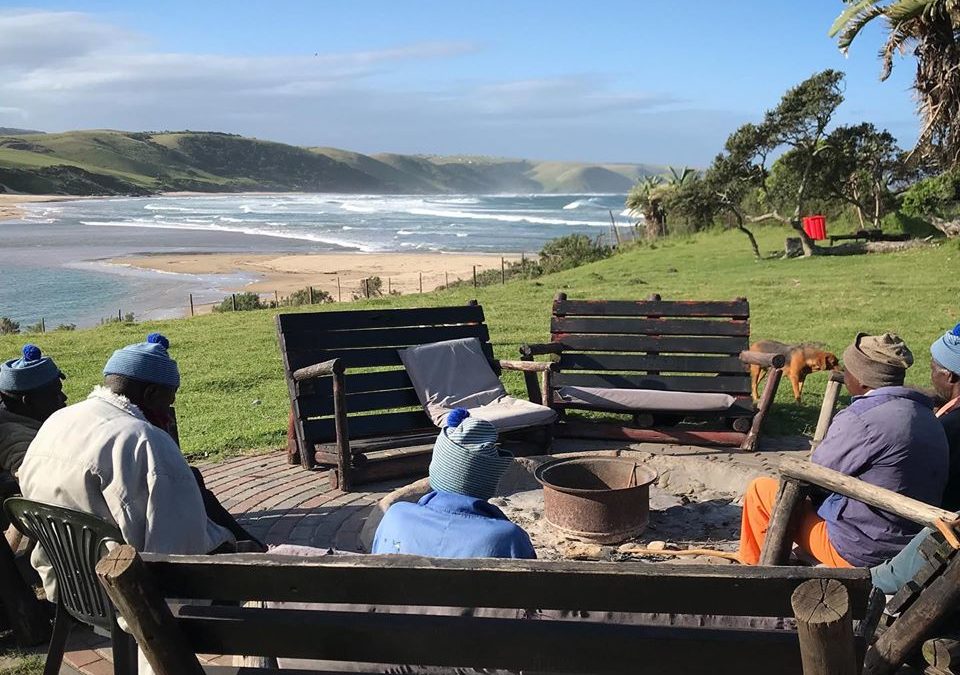
On Sunday, March 15th, President Cyril Ramaphosa announced the National State of Disaster. With the news, we began to work on a strategy to protect our communities.
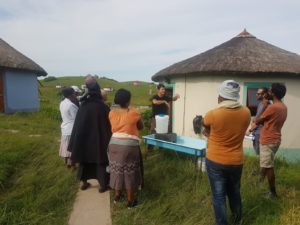
Bulungula Lodge staff training for the Safe Home Venues, ‘Amakhaya Wokuzikhusela’
Immediately, through meetings and pamphlets, we implemented an information dissemination campaign for all staff (190 employees) across the Bulungula Incubator projects.
Most importantly, with the support and advice of local traditional leadership, our communties, and infectious disease specialists, we outlined a Safe Home Venue Strategy for protecting the elderly and most vulnerable (those with pre-existing health conditions including TB, HIV, and heart conditions) in our communities.
A week later, on Monday, March 23rd the President announced that a National Lockdown would come into effect on midnight Thursday, March 26th. In the limited time, we came together as a community to set up the Safe Home Venues. We identified and interviewed elderly and people at risk, communicated with families, trained Safe Home Venue staff, built fences around Safe Home Venues, organised food and material supply, and sterilised Safe Home Venues.
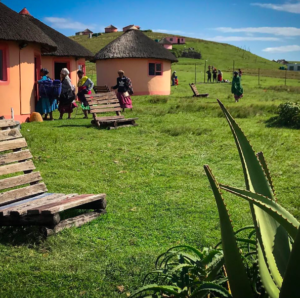
Community members moving into their huts for National Lockdown at the Bulungula Lodge, Safe Home Venue
By Thursday, March 26th, our hard and diligent work paid off and 71 community members were safe and being cared for at our Amakhaya Wokuzikhusela (Safe Homes).
Our Safe Homes have been featured on The Daily Maverick, in both news and podcast form! (Read and listen here: article, podcast)
During the National Lockdown, our staff stayed home but kept busy remotely to ensure that our communities had access to information and resources. The BI created daily content on the Bulungula Radio for localised information for the region; created informational videos in isiXhosa (watch them here); distributed food parcels to families with in need with young children; distributed free bleach to households via local spaza shops; worked with the local Chiefs and traditional leadership to inform communities on the virus, and to train spaza shop owners; created informational posters and translated them into all major languages for national distribution to over 170,000 spaza shops and thousands of NGOs (view here); and provided access to a registered nurse for local collection of chronic medication at hospitals for local distribution.
On Monday, May 4th, in adherence to the National Level 4 Risk Adjusted Strategy, the BI re-opened permitted sectors to continue to perform essential community services.
To keep our work space safe, we require: all persons entering the premises to be wearing a mask; all persons to wash their hands upon entry; shared surfaces to be wiped down with a bleach solution three times a day; all persons to maintain a 2 meter space (we have rearranged our work desks to be in five different rooms with a maximum of four people); and all parcels arriving from outside to be sprayed down with a bleach solution and be placed in the sun.
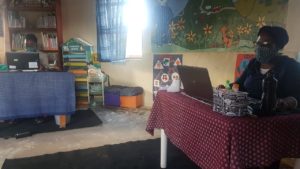
BI Staff back at work, 4 May
In order to protect more community members, we are creating an informational video, and training our Home Based Carers on how to create an isolation hut within a rural homestead. Our Home Based Carers will also be conducting ongoing COVID-19 health screenings in our communities.
We have re-opened our Agricultural Centre to distribute seedlings and other agricultural inputs for increased food security. Additionally, we will give out food vouchers to families in need to be redeemed at local spaza shops.
We will continue to use the Bulungula Community Radio as an integral part in the dissemination of information, as well as a platform to facilitate educational programmes. We are also running daily ‘Mask Challenge’ competitions on Bulungula Radio (with R30 airtime prizes!!) in order to incentivize safe COVID-19 health practices.
Since March 18th, schools have been suspended due to COVID-19 protocol. Grade 7 and 12 learners are scheduled to return back to school on June 1st, 2020, however, all other learners are required to continue to stay home. In our communities, access to e-learning is difficult due to a lack of sufficient technology and electricity within individual homesteads. In response, our teachers and project facilitators have worked with learner’s families to setup WhatsApp learning groups (data provided by the BI). In addition, we are implementing a workbook catch up plan through the Bulungula Radio, audio, and video lessons from teachers. Furthermore, we are developing an Intermediate Phase education catch up plan using online Mathematics and English programmes.
For our Preschools, we are developing a catch-up Plan for Early Childhood Development with toy, book, and educational material using the Bulungula Radio. We are incentivizing our electronic interventions with cheap smart phones and airtime.
Finally, we are preparing our online and remote learning for our Job Skills Programme to launch in June 2020.
We are working hard to keep informed and support our communities with the rapidly evolving circumstances. Throughout this chaotic time, we have received an outpouring of support from our broader Bulungula community. Thank you to all who have contributed to our ongoing efforts— your support has been vital!
For more information about current fundraising focus areas and budgets, please contact Rejane Woodroffe at rejane@bulungulaincubator.org.
Note: We receive ongoing advice and consultations with an Infectious Disease Specialist who has lived and worked in remote rural areas and the Clinical Heads of our local hospitals. All health plans have been developed under their advice.